
MAP Journal
Lessons, reflections, and news from the studio. A place to keep practicing, wherever you are.
Artistic Growth
July 2026
The annoying thing about growing is that it feels worse before it feels better. You feel worse at the thing before it gets better, and we have to learn to tolerate that.
The first thing that happens when you start to grow is awareness. You become aware that there’s a need for growth, and that alone requires an incredible amount of humility and discipline. Then comes the assessment. How much does this need to grow? How hard is this going to be? Is it really necessary? Could I just look away? Could I stop noticing it? Our bodies are built toward not growing and not changing, that’s just the law of physics we’re up against, so the real question becomes: do I conquer that, or do I ignore it? How bad is it, really? How much is it bugging me?
Then there’s a period of tremendous discomfort as we accept that we need to grow at all. Increasing awareness, increasing frustration, and underneath it a desire to collapse into some kind of story that lets us off the hook, a story that makes us a victim of our own life instead of someone still becoming. In the age of social media and instant responses, not getting instant feedback that you’re actually growing is exacerbated, but it’s also an old, old pain. Am I really growing? Is it changing? I can’t tell yet. That’s a worry as old as time, we’ve just gotten less able to tolerate the ambiguity of it.
Here’s what I know about that pull toward the story instead of the discomfort. For years I used to joke that I was too cool for Hallmark movies. Not enough money in it, I’d say. It’s shitty, I’m not good at it, I’m more Aaron Sorkin style. What I was actually doing was avoiding the discomfort of that hope and optimism, that genuine, gentle world made me nervous, I didn’t believe myself in it. So instead of doing the work to believe myself over there, I wrote a really cool story. I organized my identity around being tough and not meant for that, decided it was cool, decided the whole thing wasn’t for me, and I didn’t give myself the attention or the time my body needed to actually learn it.
Maybe we all do this. We write a story to absolve ourselves of the responsibility of growth. I invite you to ask yourself where you’re writing a story instead of hearing your body, or your artist, asking you to grow.
An Artist’s Heartbeat
May 2026
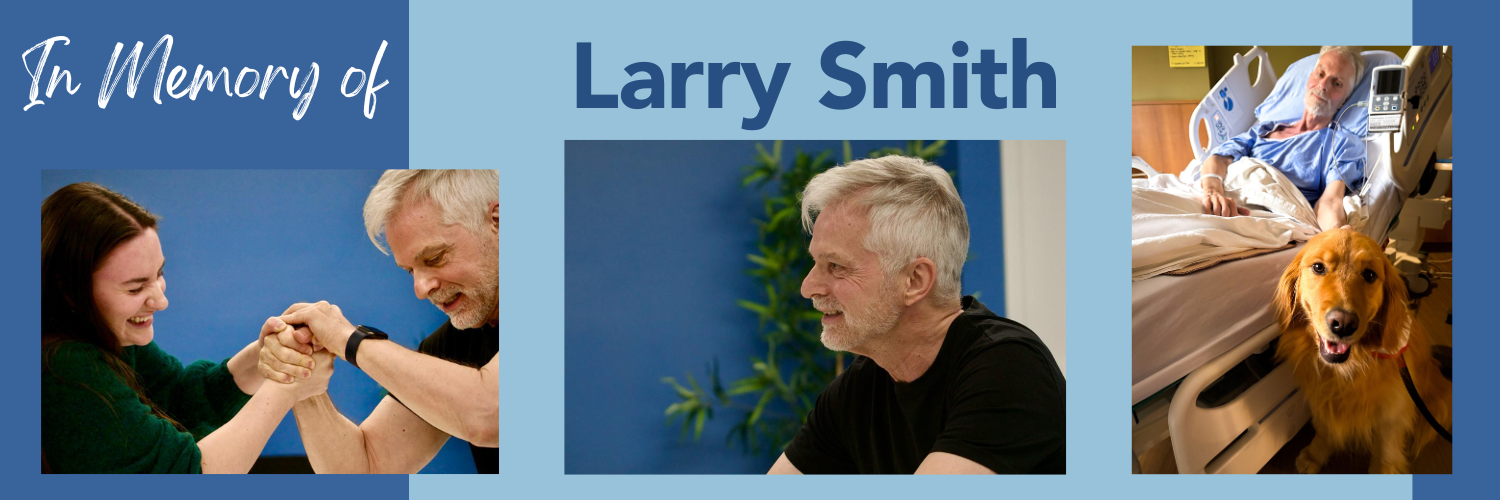
2 weeks ago I was lucky enough to visit Larry Smith in Palliative Care. He was a longtime member of the MAP community and a friend. He had asked me to come, because he had things he wanted to tell me.
He grabbed my hand. He was in palliative care and he was lit up. He had things he wanted to tell me, and he wanted me to bring them back to the room.
He told me that as things had gotten worse, and then better, and then worse again, something unexpected had been happening at the same time. This extraordinary opening up of compassion and love and receiving love. He said it was magical. And horrific. Both at once. And that it kept reminding him of scene work. Of those moments when you just don’t want to go there. I don’t want to go there. I don’t want to go there. And then you do. And there’s this release. This surrender. And the freedom that comes.
He said once he accepted what had to happen, he was just filled with so much love and magic and beauty. And while we were sitting together he pulled out a book that had been his mom’s, one he didn’t even know how he’d ended up with, and inside was a card she had left him. It said: I love you, Larry. Love, Mom. He looked at me and said Meredith, this is the kind of magic that has been happening to me. This is everywhere.
There was a music therapist in the palliative unit and they were working on something together. She was recording his heartbeat and they were going to fill it with things, he wasn’t sure exactly what yet, but he had ideas and he was so excited about it. He was making art in his last days because it brought him joy. That’s who he was. He didn’t mention the last union jobs he booked. He talked about the heartbeat project.
He also brought up a conversation we’d had years ago when I told him I didn’t know him. That after all our time together I still didn’t know who he was because his art wasn’t showing me. He said that was one of the most important conversations of his life. He had been erasing himself in his work without fully knowing it. And when he finally let his art look like him, everything opened up.
He asked about every single person in his class by name. Where they were in their work. What was happening with them. He wanted to know all of it and he wanted to send his love back.
And then he told me that other than his family, these classes had been the best thing for him in his whole life.
Larry wanted me to share this with all of you. So this is my best attempt.
Inside the Art
April 2026
I came across something recently called Liberty horse training and I haven’t been able to stop thinking about it. It’s a magical way of working that on the face of it makes no sense. There’s no contact between the horse and the trainer. No reins, no halter, no whip. The horse can leave at any time. Nothing happens without the horse choosing it. Until it trusts you and your nervous system, nothing else can happen. Much like class.
You can’t fool a horse that your nervous system is ready. And you can’t fool an audience that you’re in connection with the art when you’re obsessing about yourself, trying really hard, judging how you’re doing. When that’s where you are, you’re in front of the art, not inside it.
• • •
A few weeks ago something happened in class that I’ve been thinking about ever since. An artist was working on a scene. Their partner, who doesn’t know them well, said a single line - you’re not from here - to the alien character they were playing. The whole room held their breath. Everyone who has been at MAP for years knows this person’s story. Everyone knew exactly how loaded that line was for them. Everyone worried, except me. Because I watched that artist pause, feel the hurt, feel the tears, and offer it to the story. And what came after was as electric as anything I’ve seen in that room. Their partner had no idea what they’d set off. The audience knew everything. And the art was gorgeous because that artist chose to let it land instead of protect themselves from it.
In the talk back they said two things. That hearing that hurt. And that was really healing.
That’s it. That’s the whole thing.
What I see in training that I find most damaging is the idea that artists need to manufacture that kind of emergency. That you need to drag something unresolved and raw into the room and shove your finger into it to feel alive, and that the electricity people feel watching that is art. It isn’t. It’s someone fighting for their life on a nervous system level and it’s intoxicating to watch but it costs you everything and gives you nothing back. You can’t keep doing it. And at some point your instrument stops responding the way it did the first time you held a gun to its head.
What that artist did was different. They were safe enough with their fear to let it touch them. The fear wasn’t resolved. It may never be fully resolved. But they had faced it enough to work with it, and when it arrived uninvited in the middle of a scene they didn’t run from it or perform it. They let it move through them and offered it to the story.
That’s what we’re building at MAP. Not armor. Not a more powerful version of yourself. Resiliency, facility, agility, and trust with your own instrument so that you can be your most free, most available, most true. So that you become the artist the audience is drawn to without knowing exactly why. We do that by learning to see ourselves. Not fix ourselves. See ourselves.
Let yourself be moved. Let yourself be touched. Let yourself be hurt. Let yourself be seen.
Let your art look like you.
The Ugly Part
March 2026
A couple of weeks ago I got sick of myself.
I started to worry I wasn’t learning fast enough, that you were going to outgrow me, that I should go find someone else’s ideas and hand those to you instead. And all of this was happening at the same time I was watching other kinds of work operate at a speed I will never match and don’t want to. The kind that promises transformation by Friday. The kind that’s built on nothing. I was having my artistic winter uglies. And I was also having a rage attack at Demi Moore. Those two things were embarrassingly related.
Then I got an email from a longtime student writing to say he’d miss class. Almost in passing, he mentioned he’d gotten some scary news from his doctor, the kind where more answers are still coming, and the waiting is the hardest part. And in the middle of telling me this, he wanted me to know that what we’re doing in class is the thing helping him sit inside the uncertainty. That he feels safe inside the moment he’s in. He was teaching me something while carrying the scariest thing he’d ever been told. I thought about the impatience I’d been dragging around for two weeks and something clarified.
Here is what I know about the work:
It takes so long because your body has to feel safe. Not your brain, your body. There is no hack. First you have to stop abusing it. Then stop trying to figure it out. Then stop bossing it around. And then just ask: can we do this now? Because that door was bolted when you were seven and somebody made fun of you, and another one when you were eleven. It's a whole series of doors locked because you couldn’t face what someone else’s truth, reflected back at you, made you feel about yourself. You can have all of those moments back. But you have to update the file. And updating the file is monotonous and boring and hard and it requires feeling safe enough with yourself to hold this: nothing I learn about myself today is going to make me a fraud. Everything I learn about myself will give me more access to more of me. I have never once seen anyone open that door and find out they’re secretly a monster. The answer is never that. It’s always more.
If you’re safe enough with yourself that a note can actually land; not as “I’m a fraud, I failed” but as what it is, an invitation to embody something. You can collaborate. As long as you’re in emergency mode, every note sounds like a judgment of your value. You end up asking the director to manage your feelings instead of letting them help you tell the story. But when you’re safe? Everything becomes material.
The same muscle that makes the work good is the muscle that lets you sit with scary news and find safety inside the uncertainty anyway. That is the same exact thing. It’s not sexy. But what we’re building in here is something you actually get to keep.
I hope some part of this finds you. I’d love to see you in class.